

FALL 2026 CONCERT
Sound of the SEAson
Nov 18, 8 PM | HEXI at The Deco Bldg
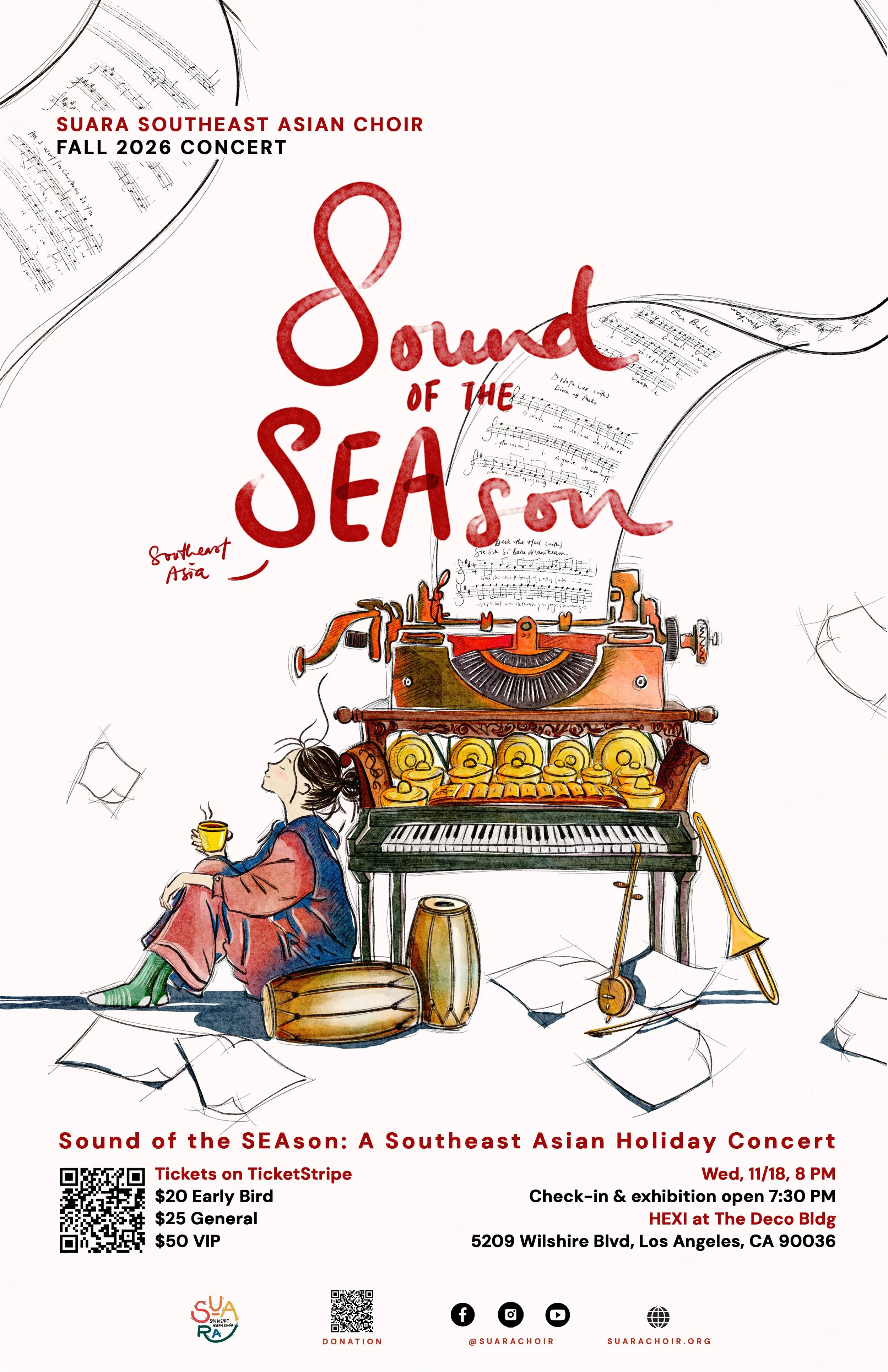
Music weaves the passage of seasons across Southeast Asia (SEA). From gamelan gong cycles driving West Sumbawa buffalo races before the rains, to Baduy angklung invoking sacred rice-planting rituals in Sunda, and work songs sustaining Peninsular Malaysia's fields. It marks time, celebrates triumphs, and gathers communities close.
As we continue Suara's work to give a suara (“voice”) to SE Asian cultural music in all its living diversity, we are often faced with the question:
Yes, Southeast Asian choral music is unique, but is it really that different from music from other traditions?
The answer is both yes and no. We embrace a distinct sonic world and approach to music-making, yet at the very core of it all, music remains a poetic platform to bring people together.
This, is what inspired our 14-song program, divided into four chapters: (1) The SEAson of Light, (2) The SEAson of Peace, (3) The SEAson of Love, and (4) The SEAson of Joy. Each chapter thoughtfully (and even nerdy-ly!) pairs seasonal music from Southeast Asia with familiar North American holiday classics to answer that question firsthand.
Yes, our sonorities are unique, but we are far more similar than we are different. Whether it is the onomatopoeic “fa-la-la” or the tongue-twisting “sik sik si batumanikkam,” we are bound by the same human impulse: finding a reason to sing, share, and gather in light, peace, love, and joy.
-
Ramon Tapales, Arr. Lucio San Pedro
Diwa ng Pasko (“The Spirit of Christmas”) is a cherished Filipino Christmas carol originally composed by Ramon Tapales, a foundational figure in Philippine music history and former director of the UP Conservatory of Music. The Tagalog text moves beyond the commercial veneer of the holiday season to reflect on its emotional core—emphasizing love, goodwill, and the quiet joy found in community.
In this choral setting, National Artist for Music Lucio San Pedro—revered for his nationalist musical idiom that infuses Western classical structures with traditional Philippine lyricism—transforms the melody into a lush, expressive work. This arrangement is known to be light, bouncy, and almost baroque-like in compound meter. Throughout, you'll hear different playful "sounds of the season" woven into the texture, such as "zum" mimicking the sound of a plucked instrument, cheerful "la la la" singing, and resonant "ding dong" bell motifs.
Text and translation
Masdan natin ang sinag ng tala sa tapat ng Belen, bayang ng ating poong dangal, at sumilang doon ang sanggol na mahal, mananakop ng buong katauhan.
Magsaya tayo, kapatirang mahal, ipagdiwang lugod sa puso. Si Hesus nating S'yang tanging Maykapal, lumuhod tayo sa harap N'ya.
Ang maganda nating bihisan ay isuot kahit na minsang at ang gintong hikaw at sing-sing ay linisin bago gamitin.
Mano po lolo, mano po ninong, ang sadya po sana'y mamasko; kung wala ma'y salamat din po, sa tatlong hari na'ng balik ko.
Buong taon muling nagdaan, kung walang ga'nong natutunan, nga yo'y magsikap sa aralan.//
Let us behold the rays of the star above Bethlehem, the town of our honorable Lord and there was born the prcious infant The Savior of all mankind
Let us rejoice, dear brothers and sisters, let us celebrate with joy in our hearts. Jesus, our only Creator, let us kneel before Him.
Let us wear our beautiful clothes, even if just for this one time. And let us polish our gold earrings and rings before wearing them.
Blessings, Grandpa; blessings, Godfather; I am here to ask for a Christmas gift. If you don't have one, that is also fine; I will just come back when the Three Kings arrive.
A whole year has passed again. If you don't one, that is also fine; I will just come back when the Three Kings arrive. -
Robert Fisher Boyce, Arr. Shawn Kirchner
Beautiful Star of Bethlehem is a beloved American southern gospel and Appalachian Christmas hymn written by R. Fisher Boyce in Middle Tennessee and published in 1940. Traditionally associated with the warmth of rural holiday gatherings, southern singing conventions, and landmark recordings by country and gospel legends, the text celebrates the celestial light that guided the Wise Men to the manger.
In this arrangement by Shawn Kirchner, the traditional hymn is reimagined with a distinctly homespun, roots-music spirit. While originally conceived to feature a solo fiddle, this evening’s performance reimagines the instrumental color with a vibrant trumpet played by one of Suara’s own members. Beneath the surface simplicity of the vocal writing lies a well-thought-out arrangement structure featuring call-and-response, an interplay between unison and four-part singing, and subtle rhythmic variations in each reprise of the refrain.
Text
Oh beautiful star of Bethlehem
Shining far through shadows dimmed
Giving the life for those who long have gone
Guiding the wise men on their way
Unto the place where Jesus lay
Oh beautiful star of Bethlehem, shine onOh beautiful star the hope of light
Guiding the pilgrims through the night
Over the mountains 'til the break of dawn
Into the land of perfect day
It will give out a lovely ray
Oh beautiful star of Bethlehem, shine onOh beautiful star
(beautiful beautiful star) of Bethlehem
Shine upon us until the glory dawn
Give us a lamp to light the way
Unto the land of perfect day
Oh beautiful star of Bethlehem, shine onOh beautiful star the hope of grace
For the redeemed the good and the blest
Yonder in glory when the crown is won
Jesus is now the Star divine
Brighter and brighter He will shine
Oh beautiful star of Bethlehem, shine on -
Euah Suntornsanan, Arr. Kittiporn Tantrarungroj
Loi Kratong was originally composed in the 1930s by Euah Suntornsanan (1910–1981). A prolific composer, educator, conductor, violinist, and singer, Suntorsanan founded the Suntaraporn big band in the 1940s. He is credited with bringing Western classical, jazz, and Latin music into Thai pop culture.
Named after the well-known Loi Kratong Festival, Loi Kratong is one of the most iconic folk songs in Thai music. This song is traditionally performed on the night of the full moon during the twelfth lunar month in the Thai lunar calendar, which usually falls in November. Loi means to float, and kratong refers to a banana-leaf lantern decorated with flowers, incense sticks, and candles. In this arrangement, Tantrarungroj explores different sonorities from the piphat ensemble in the verses. Onomatopoeic syllables such as “tung,” “mung,” “tong,” and “patong” are used to emulate the sounds of Thai gongs and bamboo xylophones. The arrangement starts and ends with staggered entrances from the lowest voice to the highest, symbolizing the gesture of sending away a krathong on the river as one expresses gratitude and asks for forgiveness from the Khongkha, the River Goddess.
Text and translation
วันเพ็ญ เดือน สิบสอง
น้ำ ก็ นอง เต็ม ตลิ่ง
เรา ทั้ง หลาย ชาย หญิง สนุก กัน จริง วัน ลอย กระทงลอย ลอย กระทง, ลอย ลอย กระทง
ลอย ลอย กระทง กัน แล้ว ขอ เชิญ น้อง แก้ว ออก มา รำวง
รำวง วัน ลอย กระทง, รำวง วัน ลอย กระทง
บุญ จะ ส่ง ให้ เรา สุข ใจ, บุญ จะ ส่ง ให้ เรา สุข ใจ//
On the Full Moon of the 12th lunar month.
Water overflows the banks.
We all, men and women
Have a lot of fun on Loi Kratong DayFloat, float the banana leaf boats
After we float our banana leaf boats
I invite you darling
To come out and dance the Ram WongDance the Ram Wong on Loi Kratong Day
Dance the Ram Wong on Loi Kratong Day
Good merit brings us happiness -
Flory Jagoda, Arr. Joshua Jacobson
Ocho Kandelikas (“Eight Little Candles”) is a joyous Hanukkah song composed by the legendary Sephardic Jewish singer-songwriter and Holocaust survivor Flory Jagoda. Written in Judeo-Spanish (Ladino)—the traditional language spoken by Sephardic Jews after their expulsion from Spain in 1492—the song captures the warmth and resilience of family traditions. The lyrics joyfully recount the lighting of the menorah night by night, celebrating each of the eight little candles alongside the eating of traditional holiday foods like bimuelos (fried dough fritters).
In this arrangement by choral scholar and conductor Joshua Jacobson, the spirited melody is brought to life with infectious syncopation and dance-like rhythms. Adding a uniquely playful spirit, this evening's performance features a completely improvised piano part alongside a kazoo solo.
Text and translation
Hanukah linda sta aki
Ocho kandelas para mi
Hanukah linda sta aki
Ocho kandelas para mi, ohMuchas fiestas vo fazer
Kon alegria i plazer
Muchas fiestas vo fazer
Kon alegria i plazerLos pastelikos vo kumer
Kon almendrikas i la myel
Los pastelikos vo kumer
Kon almendrikas i la myel, ohUna kandelika, dos kandelikas
Tres kandelikas, kuatro kandelikas
Sintyu kandelikas, sej kandelikas
Siete kandelikas, ocho kandelas para mi//
Beautiful Hanukkah is here Eight candles for me Beautiful Hanukkah is here Eight candles for me, oh
I will make many celebrations With joy and pleasure I will make many celebrations With joy and pleasure
I will eat little pastries With little almonds and honey I will eat little pastries With little almonds and honey, oh
One little candle, two little candles Three little candles, four little candles Five little candles, six little candles Seven little candles, eight candles for me
-
Thomas Tallis
O Nata Lux (“O Light Born of Light”) stands as a crowning achievement of English Renaissance polyphony, originating in Thomas Tallis’s landmark 1575 collection Cantiones Sacrae, published under a royal patent granted jointly to Tallis and his pupil William Byrd. Set for five-part a cappella chorus, the Latin text functions as a hymn for the Feast of the Transfiguration, imploring Christ—the light born of light—to mercifully accept the praises and prayers of the faithful.
In this setting, Tallis uses interlocking imitation and smooth suspensions to build a transparent, quiet acoustic space. Beneath the serene counterpoint, he employs deliberate word painting, introducing sharp, unconventional dissonances on key theological words—most noticeably on the sacred name Jesu and corporis (the body).
Text and translation
O nata lux de lumine
Jesu redemptor saeculi
Dignare clemens supplicum
Laudes preces que sumereQui carne quondam contegi
Dignatus es pro perditis
Nos membra confer effici
Tui beati corporis//
O Light born of Light,
Jesus, redeemer of the world,
with loving-kindness deign to receive suppliant praise and prayer.Thou who once deigned to be clothed in flesh
for the sake of the lost,
grant us to be members of thy -
Ily Matthew Maniano
Amihan (“The Northeast Wind”) is an evocative contemporary choral work by Filipino composer Ily Matthew Maniano, featuring text written by the composer. The Tagalog text frames a quiet conversation with the amihan—the cool, dry northeast monsoon originating from Siberia and northern China that brings pleasant weather to the Philippines. The speaker seeks comfort and guidance, asking the wind to carry away worries, ignite passion in the heart, and illuminate the path forward.
The composition employs a minimalist approach structured around two juxtaposed melodies that mirror a dialogue between the speaker and the receiver. To capture the unpredictable, life-giving nature of the wind, Maniano incorporates aleatoric elements, in the opening and closing sections, where performers are invited to express the sounds of a sigh, a sudden chill, or a gentle breeze.
Text and translation
Hangin Amihan, yakapin mo,
balutin mo, ingatan mo kami.
Sa simoy na ‘yong dala, diwa nawa’y mapalaya’t
bigyang alab aming mga pusoHang Amihan, hilumin mo,
akayin mo, aluin mo kami
sa bawat ihip ng ‘yong hangin
//
Amihan, embrace,
cover, protect us.
May the breeze that you bring free our minds
and keep our hearts ablaze.
Amihan, heal,
lead, comfort us
in every blow of your wind. -
Trad. Kelantanese, Arr. Muhd. Amirul Hamid
Ewa Bule (commonly known as Wau Bulan, or "The Moon Kite") originates from the state of Kelantan in northeastern Peninsular Malaysia. The song belongs to dikir barat, one of the few traditional communal singing traditions native to the Malay Archipelago. Historically, both the song and the flight of the ornate wau bulan moon kite are traditionally performed and celebrated after the paddy fields have been cleared following the harvest season.
While built around a deceptively simple, six-note traditional melody, this setting by Malaysian composer Muhammad Amirul Abdul Hamid transforms the folk tune into an evocative narrative journey. Hamid demonstrates a complete mastery of melodic, rhythmic, and harmonic variation, guiding the listener from the initial stirring of the wind to a sky bursting with flying moon kites.
Text and translation
Ewah buleh, ewah buleh,
Teraju tigo.Alah ewah, ewah buleh,
Teraju tigo.
Alah sambut, lah saleh,
Sambut saleh, dari pantai timor
Mari-mari hadirin hadirat,
Sama-sama bersuka-rio//
Oh wow, the moon kite!
The three-cornered kite.Oh wow, the moon kite!
The three-cornered kite.
Greetings from the east coast!
Come, dear guests,
Let’s have a wonderful time together this evening. -
Trad. Vietnamese, Arr. Yu Hang Tan (WORLD PREMIERE)
Bèo dạt mây trôi (“Floating Duckweed, Drifting Clouds”) is a Northern Vietnamese folk song expressing the poignant longing, melancholy, and fidelity of a person separated from their loved one. The text centers on one sentiment: “sao chẳng thấy anh” (“yet nothing to be seen”). This melancholic refrain echoes over and over, amplified by the evocative imagery of floating duckweed and drifting clouds that symbolize the transient, wandering nature of those waiting in vain.
In this arrangement by Yu Hang Tan, the traditional melody is reimagined through an intricate counterpoint of rhythm and texture. The accompaniment features a flowing, water-like piano part set entirely in a 12/8 compound meter that deliberately flows against a melody strictly held in duple time. Framing the work are quiet, intimate solo passages at both the beginning and the end. At its center, the arrangement breaks open with a brilliant, virtuosic piano solo. Echoing structural elements found in Ewa Bule, the piece also features a swift chromatic mediant modulation, propelling the chorus toward a unison finale.
Text and translationBèo dạt, mây trôi, chốn xa xôi
Em ơi, anh vẫn đợi bèo dạt
Mây trôi, chim ca tang tính tình, cá lội
Ngẫm một tin trông
Hai tin đợi, ba bốn tin chờ
Sao chẳng thấy đâu?Một mảnh trăng treo suốt đêm thâu
Em ơi, trăng đã ngả ngang đầu
Thương nhớ ai, sương rơi, đêm sắp tàn, trăng tà
Cành tre đưa trước ngõ
Là gió la đà, em vẫn mong chờ
Sao chẳng thấy đâu?//
The water ferns drift as the clouds float,
Darling, I’m still waiting as the ferns drift on.
Clouds float, birds sing, fish swim.
Pondering one message of hope; two messages of longing; three, four messages of anticipating,
yet nothing to be seen.
A piece of moon hangs throughout the night,
Oh dear, the moon has tilted above,
Longing for someone, dew falls, the night nears its end, the moon fades,
The bamboo branches whistle in the winds,
I’m still longing,
Yet nothing to be seen. -
Adolphe Adam, Arr. John Rutter
O Holy Night (“Cantique de Noël”) is one of the most beloved and enduring Christmas carols in the Western tradition, originally composed in 1847 by French composer Adolphe Adam to a French poem by Placide Cappeau. The text contemplates the sacred and awe-inspiring night of Christ's birth, celebrating the redemption of humanity, the breaking of oppression, and a divine message of universal love and freedom.
In this setting by English composer John Rutter, the familiar melody receives an expansive treatment. While originally written for chorus and solo, tonight’s performance features Suara's vocal coach, Kaitlyn Son, on the soprano solo. Set in a 12/8 compound meter—mirroring Bèo Dạt Mây Trôi earlier in the program—Rutter’s arrangement combines vocal lines with rich harmonic accompaniment, balancing quiet reflection with dynamic expressions of joy.
Text
O holy night, the stars are brightly shining;
it is the night of the dear Savior’s birth.
Long lay the world in sin and error pining,
till He appeared and the soul felt its worth.
A thrill of hope, the weary world rejoices,
for yonder breaks a new and glorious morn!
Fall on your knees! O hear the angel voices!
O night divine! O night when Christ was born!
O night divine! O night, O night divine!Truly He taught us to love one another;
His law is love and His gospel is peace.
Chains shall He break, for the slave is our brother,
and in His name all oppression shall cease.
Sweet hymns of joy in grateful chorus raise we,
let all within us praise His holy name.
Christ is the Lord! O praise His name forever!
His pow'r and glory evermore proclaim!
His pow'r and glory evermore proclaim! -
Trad. Malay Archipelago, Arr. Yu HAng Tan
Rasa Sayang (Feelings of love) is arguably one of the best-known folk songs in the Malay Archipelago, a region encompassing modern-day Indonesia, Malaysia, Singapore, and Brunei. A folk song that encapsulates much of the Malay character––that special combination of conviviality, playfulness, earthiness, sensuality, subtlety, and charm––Rasa Sayang is often performed at weddings, convocations, international events, and opening and closing ceremonies for all kinds of events. Set for mixed chorus, piano, and kompang (Malay hand drum), this arrangement borrows inspiration from the interlocking textures of the Malay gamelan and the bright and forward timbre from Malay folksongs.Text and translation
Rasa sayang, hey rasa sayang sayang hey.
Lihat nona jauh rasa sayang sayang hey.Pisang emas dibawa belayar,
Masak s’biji di atas peti.
Hutang emas boleh dibayar,
Hutang budi dibawa mati.//
I feel loved, hey!
Look at the girl in the distance.Golden bananas were brought on a sailing trip,
One ripened on the chest.
The debts of gold we can repay,
But the debts of kindness last through life -
Mariah Carey and Walter Afanasieff, Arr. Mac Huff
All I Want for Christmas Is You is a holiday standard composed by Mariah Carey and Walter Afanasieff. Released in 1994, the track pairs a soaring, Motown-inspired pop melody with festive lyrics about prioritizing love over material gifts during the holidays.
In the Philippines—home to the world's longest holiday season, which officially kicks off when the "Ber" months begin on September 1st—this smash hit serves as a cultural touchstone. Alongside local staples like Jose Mari Chan’s Christmas in Our Hearts, Carey’s anthem immediately floods shopping malls, radio airwaves, and public spaces. It is famously a staple for Filipino karaoke-goers, where holiday gatherings inevitably turn into high-energy group sing-alongs. In Mac Huff’s arrangement, the pop-gospel energy of the original translates seamlessly to the choral stage, offering a joyful and nostalgic crowd-pleaser.
Text
I don't want a lot for Christmas
There is just one thing I need
I don't care about the presents
Underneath the Christmas tree
I don't need to hang my stocking
Upon the fireplace
Santa Claus won't make me happy
With a toy on Christmas DayI just want you for my own
More than you could ever know
Make my wish come true
All I want for Christmas is youI won't ask for much this Christmas
I won't even wish for snow
And I just wanna keep on waiting
Underneath the mistletoe
I won't make a list and send it
To the North Pole for Saint Nick
I won't even stay awake to hear
Those magic reindeer clickI just want you here tonight
Holding on to me so tight
What more can I do?
Oh, all I want for Christmas is youOh, the lights are shining
So brightly everywhere
And the sound of children's
Laughter fills the air
Everyone is singing
I hear those sleigh bells ringing
Santa, won't you bring me the only one I need?
Won't you please bring my baby to me?I don't want a lot for Christmas
This is all I'm asking for
I just want to see my baby
Standing right outside my doorI just want you for my own
More than you could ever know
Make my wish come true, baby
All I want for Christmas is you -
Trad. Batak, Arr. Pontas Purba
Born in Sidikalang, North Sumatra, Indonesian composer and conductor Pontas Purba has dedicated his career to shaping church, university, and community choral traditions.
Sik Sik Si Batu Manikkam is a Batak folk song that sets a traditional pantun—an Indonesian poetic form where a setup (pembayang) establishes the rhyme scheme before leading into the hidden meaning (maksud). In this rare example, the pantun consists of a tongue-twister set entirely to nonsense syllables. In this arrangement by the composer, the work opens with onomatopoeic vocal writing that imitates the distinctive timbres and articulations of a gamelan ensemble's gongs. The music drives toward an exhilarating finale as the choir navigates rapid-fire tongue-twisters coupled with an accelerating upward modulation.
Text
Sik sik si batu manikkam ni parjoget,
Sor ma di gottam di na mangingani.
Si bambangkara jula-jula,Habang birrik-birrik, santabi loloan on,
dipatangkas dipatilik bohi nahurapon on.Dang tutu sihupi ianggo so marsuga suga,
Dang tutu na uli ianggo so denggan marroha.//
These lines do not have any meanings.
They are only funny lines which rhyme and lead to the rest of the text.
No meaning--written to rhyme with the next line.
The more you look you can see that my face has blemishes.
No meaning--written to rhyme with the next line.
Beauty is worthless if you don't have a beautiful character.
-
Trad. Welsh, Arr. Yu Hang Tan (WORLD PREMIERE)
Deck the Hall is a traditional Welsh Christmas and New Year carol with origins tracing back to the sixteenth century. The famous melody first appeared in print in the 1784 collection Welsh Harper, though the lively "fa-la-la" refrain was added much later in the nineteenth century, and the well-known English lyrics by Thomas Oliphant were published in 1862. Traditionally associated with Nos Galan (New Year's Eve) celebrations around the winter hearth, the text joyfully welcomes the holiday season and bids farewell to the old year.
In this world premiere arrangement by Yu Hang Tan, the familiar tune receives a dynamic, expansive treatment featuring four-hand piano writing, a solo trumpet, and percussion. Employing frequent modulations to guide the listener seamlessly through all three verses, the arrangement creates a bridge to Sik Sik Si Batu Manikkam earlier in the program through their shared use of onomatopoeia: just as Sik Sik Si Batu Manikkam builds its rhythmic foundation on nonsense syllables, Deck the Hall relies on its iconic "fa-la-la" refrain to drive the festive momentum forward.
Text
Deck the halls with boughs of holly,
fa la la la la, la la la.
'Tis the season to be jolly,
fa la la la la, la la la.
Don we now our gay apparel,
fa la la la la, la la la.
Troll the ancient Yuletide carol,
fa la la la la, la la la.See the blazing Yule before us,
fa la la la la, la la la.
Strike the harp and join the chorus,
fa la la la la, la la la.
Follow me in merry measure,
fa la la la la, la la la.
While I tell of Yuletide treasure,
fa la la la la, la la la.Fast away the old year passes,
fa la la la la, la la la.
Hail the new, ye lads and lasses,
fa la la la la, la la la.
Sing we joyous all together,
fa la la la la, la la la.
Heedless of the wind and weather,
fa la la la la, la la la. -
Trad. Aceh, Arr. Paul Widyawan
Bungong Jeumpa (“The Champaca Flower”) is a celebrated traditional folk song from the Aceh province on the northern tip of Sumatra, Indonesia. The title refers to the fragrant jeumpa flower (magnolia champaca), a bloom deeply revered in Acehnese culture for its striking beauty and sweet aroma. The text uses the blossom as a symbol of grace, pride, and the vibrant identity of the Acehnese people, frequently accompanying traditional folk dances where performers execute elegant, synchronized hand and body movements that mirror the blossoming of the flower.
Text and translation
Bungong Jeumpa Bungong Jeumpa
Meugah di Aceh
Bungong teuleubeh teuleubeh
Indah lagoinaPuteh kuneng meujampu mirah
Bungong si-ula indah lagoina
Lam sinar buleun lam sinar buleun
angen peu ayon
Luroh meususon meususon yang mala malaMangat that meubee meunyoe tatem com
Leupah that harom si bungong jeumpa//
Champaca Flower, Champaca Flower Famous in Aceh
The most wonderful flower
So beautiful in styleWhite, yellow, mixed with red
The si-ula flower,
so beautiful in styleIn the moonlight, in the moonlight rocked by the breeze
Falling in neat rows, wilted and fading So sweet-smelling if one dares to kiss it
Extremely fragrant, the champaca flower
3,732 measures, $4/measure, $15,000 goal!
$4/measure may seem small--less than the price of a cup of coffee. But multiply that by 3,732 measures, and it adds up quickly for a small community ensemble that has only been around for four years.
Over the past 12 months, we have worked tirelessly to secure support through grants, silent asks, and paid performances to map our biggest season to date. In June 2027, Suara will perform at the prestigious Chorus America national conference as one of the eight selected choirs, presenting a 25-minute concert in front of choral leaders across the country. A month later, we are going on our first international concert tour to Canada, participating in the 2027 HarbourVOICES International Festival of Collective Singing.
Today, we are reaching out to our community to get us across the finish line. Gathering this additional $15,000 will directly support our mission: provide travel financial assistance for our singers heading to Canada—many of whom are still university students; allow us to pay for extra rehearsals as we prepare what might be our most important performance to date at Chorus America; and sustain the full ecosystem behind an artistic organization: insurance, accounting, website hosting, and the many unseen costs that make this work possible.
$4 sponsors 1 measure
$20 sponsors 5 measures
$160 sponsors 40 measures (2 general admission tickets)
$400 sponsors 100 measures (2 VIP tickets + 1 Suara t-shirt)
$800 sponsors 200 measures (4 VIP tickets + public recognition + 2 Suara t-shirt)
Every sponsored measure solidifies our first promise – “We Are Here To Stay” - while giving a “suara” (voice) to our next chapter of artistic reach in North America. (or in the North American choral landscape).
Suara Southeast Asian Choir is a sponsored project of Fractured Atlas, a non-profit arts service organization. Contributions for the charitable purposes of Suara Southeast Asian Choir must be made payable to “Fractured Atlas” only and are tax-deductible to the extent permitted by law.