

SPRING 2026 CONCERT
Seven Songs, Seven Games
March 11, 8 PM | HEXI at The Deco Bldg
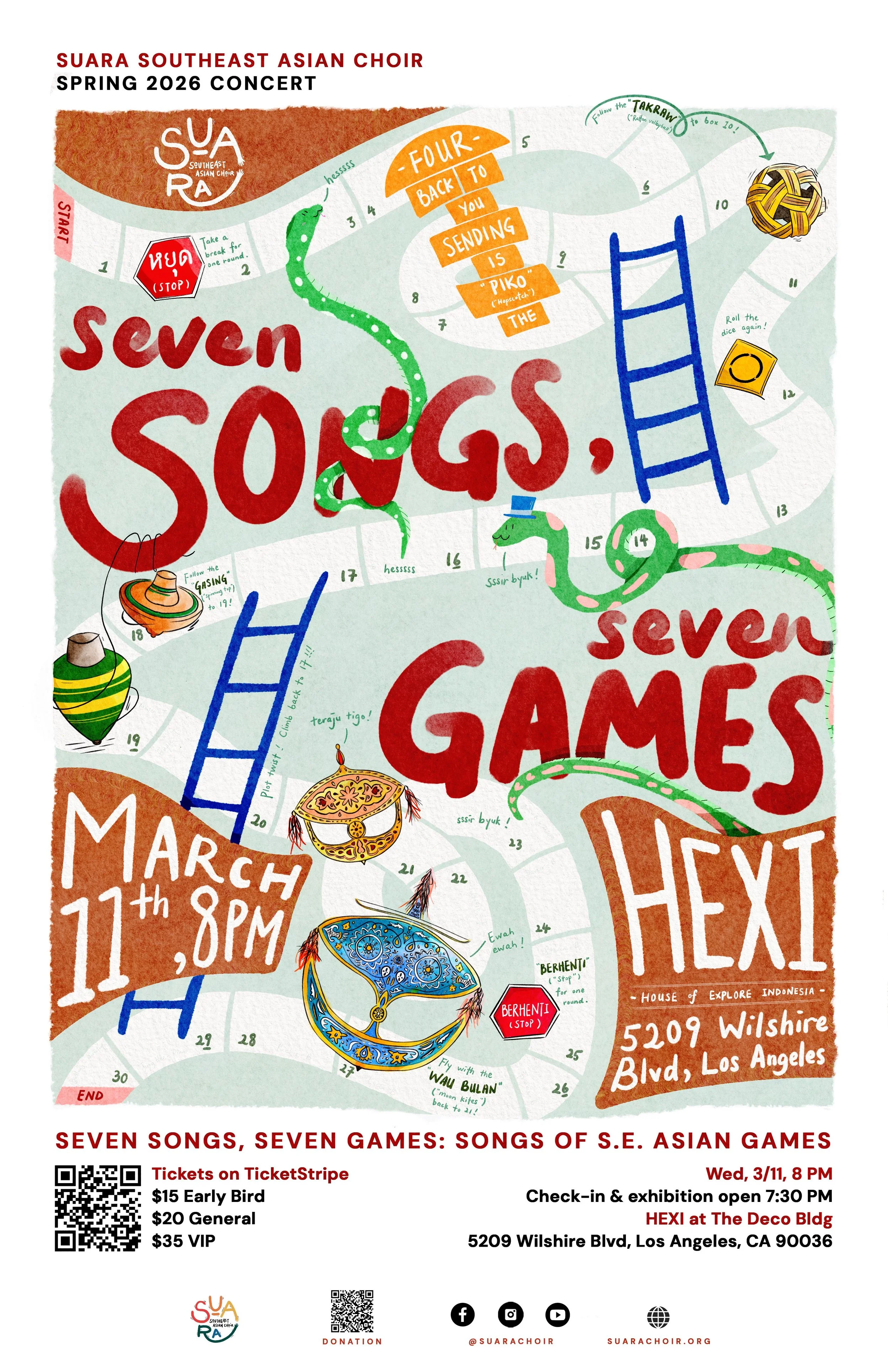
Play lives at the heart of Southeast (SE) Asia. Across alleyways, schoolyards, and living rooms in front of TVs blasting soap operas, games have long been a central way communities gather, learn, and pass on traditions. Tug-of-war ropes stretch across dusty grounds, nursery rhymes determine who is “it,” finger-counting games travel from hand to hand, and playground commands like “red light, green light” send children running and freezing in bursts of laughter. Even some games—sometimes violent—that we certainly do not endorse have long been part of the region’s folklore. These moments of play carry nostalgia, social values, and the sounds of communal life, often passed from generation to generation.
Seven Songs, Seven Games grew out of Suara’s ongoing effort to spread SE Asian musical traditions and communal singing practices throughout the greater Los Angeles area. As we began programming this concert, we asked ourselves:
how can we share this culture in a way that truly invites people in? Well, what better way to do that than through play?
The program also comes from a place of recognizing how play connects us across cultures. Songs and games offer a way to reconnect with the early forms of socialization that shaped us. While tonight’s program is rooted in SE Asian cultures, they also reveal something strikingly universal. Take AEIOU, inspired by the stop-and-go children’s game played across the Malay Archipelago: in the United States, children know it as “Red Light, Green Light”; in Mexico, it becomes Un, dos, tres, calabaza!; in Korea, 무궁화 꽃이 피었습니다 (Mugunghwa kkoci pieot seumnida); and in Morocco, children call out واحد، جوج، تلاتة، جمد (Wahd, joj, tlata, jemd). Across languages and continents, the rules may change, but the laughter is the same—a reminder that play, like music, is a shared language that connects us all.
-
Trad. Filipino, Arr. Jude B. Roldan
Pin Pin de Sarapin is a fingerplay song and counting-out chant from Capiz in the central Philippines. Traditionally sung by children during games, it accompanies a playful elimination ritual: a player touches each finger of the participants in sequence, bending whichever finger the chant lands on at the end. The process repeats until only one finger remains unbent, determining who will be tayá (“It”). Much like the English rhyme “eenie, meenie, miney, moe,” Pin Pin de Sarapin is largely composed of playful nonsense syllables.
In this arrangement, Filipino composer Jude B. Roldan transforms the sixteen-measure chant into a theatrical work. Ever-changing tonal centers and rhythmic and harmonic textures keep the music constantly in motion. The arrangement opens with a homophonic section that pivots between tonal centers every eight measures before brief canonic passages propel the music into a dramatic spoken chorus. A slower middle section places the singers in close major- and minor-second harmonies. A final accelerando canon ties the music back to its opening material, culminating in a high-energy spoken chant: “tigbak, buang, binuno, aswang!”—a string of mischievous words referencing being put away, madness, stabbing, and the mythical witch-like creature of Philippine folklore.
Text and translation
Pin pin de sarapin,
De kutsilyo, de almasin,
Hawhaw di karabaw batutin.Sayang pula, tatlong pera,
Sayang puti, tatlong ka salapi.
Tigbak,
buang,
binuno aswang!//
Translation by the arranger
Since this is a children's game, the words are all nonsensical.pinpin = no literal meaning
de = the/with
sarapin = no literal meaning
kutsilyo = knife
almasin = warehouse
haw-haw = no literal meaning
karabaw = (carabao) water buffalo
batutin = smelly
sayang = skirt
pula = red (color)
tatlong = three
pera = money
puti = white (color)
ka = a
salapi = fifty-centavo coin
tigbak = put away
buang = crazy
binuno = stabbed
aswang = mythical creature (witch/vampire-like) -
Trad. Burmese, Arr. Nyi Nyi Myin
Mama Wawa (“The chubby sister”) is a beloved Burmese nursery rhyme traditionally taught to young children as an introduction to the Burmese language. The lyrics tell of a young sibling who wishes to dance with their sister. As with many folk songs across Southeast Asia, its melody is short and repetitive, but there lies the charm and educational value of this nursery rhyme––its catchiness. Notably, this arrangement is one of the very few Burmese choral works ever published, making its performance here a rare opportunity to give voice to a tradition seldom heard in choral settings—a reflection of the spirit and heart of this concert.
In this arrangement, Burmese composer and conductor Nyi Nyi Myin characterized this simple melody with contrasting textures. The piece opens with each voice repeating its own motif, later shifting between homophonic and canonic singing. When the treble voices carry the melody, the lower voices provide repeated motifs that echo the textures of the hsaing waing (traditional Burmese gong-chime) ensemble, where melodic lines are supported by steady rhythmic patterns from gongs and drums. Throughout, subito piano (suddenly soft) moments punctuate the music, evoking the sudden dynamic shifts typical of hsaing waing performances—often mirrored by dramatic changes in dancers’ movements.
Text, transliteration, and translation
မမ ဝဝ (mama wawa)
ထထ က (tata ka)
အ က ပထမ။ (aka pha-tama)
ကပါ ကပါ (kapa kapa)
မမရာ (ma ma-ya)
ညည လသာသာ။ (nyanya la sa sa)
ညအခါ (nya a-ka)
ငါ စာရ (nya saya)
မမ ဝဝ (mama wawa)
ထထ က။ (tata ka)//
Chubby sister,
Come dance.
She’s the best at dancing.
Dance! Dance!
Sister,
Under the bright moon at night.
In the evening,
After I finish studying,
Chubby sister,
Come dance. -
Trad. Malay Archipelago, Arr. Tracy Wong
Lenggang Kangkung is a folk song from the Malay Archipelago. The word lenggang refers to a swaying walk, while kangkung (water spinach) evokes the image of leafy vegetables gently moving by the marsh. Set in pantun, a traditional Malay poetic form that blends humor with social commentary, the lyrics include a reference to menyabung (cockfighting), a blood sport historically practiced across SE Asia in which domesticated roosters are pitted against one another. In this second half of the pantun, the wife voices her disapproval: “balik dari menyabung, makanlah nasi sahaja” (“coming home from cockfighting, plain rice is all you get”). In SE Asia, meals typically pair rice with a variety of side dishes; being served only plain rice signals a subtle form of punishment.In this arrangement, Malaysian-Canadian composer Tracy Wong sets the folk tune into a rhythmically vibrant choral work for 2-part chorus, percussion, clapping, and flute. Singers frequently sustain the “ng” consonant—heard in words like lenggang and kangkung—to mimic the shimmering resonance of the gamelan ensemble. Combined with hand percussion and body percussion, these textures reinforce the swaying, dance-like groove suggested in the title.
Text and translation
Lenggang lenggang kangkung,
Kangkung di tepi paya.
Balik dari menyabung,
Makanlah nasi sahaja.//
The swaying water spinach,
That grows by the marsh.
If you’re coming from a cockfight,
Plain rice is all you get. -
Trad. SE Asian Playground Chant, Daniel Montes de Oca Tellez
Inspired by the popular children’s game of the same name, AEIOU! is an experimental choral work with elements of suspense and real-time gameplay. This piece is based on the game played by school children throughout the Malay archipelago, where a distant leader must be tagged by a player in a larger group, but the group may only move closer whenever the leader is not looking. The leader chants: “A, E, I, O, U!”, and turns around. Whoever moves is now eliminated. Taking inspiration from the social, physical, and emotional dynamics emerging from the game’s ruleset, Mexican composer Daniel Montes de Oca Téllez proposes a piece teasing one of the game’s most striking lessons: while it is feasible to move about cautiously and never get caught, this game is most often won (or lost) by those willing to take a healthy amount of reckless risks.
Text and translation
AEIOU
//
AEIOU - Nonsense syllables
-
Wichian Tantiphimonphan, Arr. Praewpraw S.
ออเจ้าเอย Or Jao Oei originates as the theme for the 2018 mega-hit television drama Love Destiny, which captivated over 10 million viewers in Thailand alone. In 2023, this series was recognized by the Thai Ministry of Culture as “an example for Thai soft power.” Set in 17th-century Ayutthaya during the reign of King Narai, the series follows a 21st-century archaeological student who dies young, only to be reborn in Ayutthaya as a grown woman, navigating the rituals of the royal court. Through its light-hearted yet historically grounded plot, the show introduced audiences to Ayutthaya’s courtly ceremonies, traditional costumes, archaic Thai language, and historic landmarks.
While Or Jao Oei is a love song at heart, its setting within the series allows listeners a glimpse into the rituals and communal life of Ayutthaya’s royal court. Praewpraw S.’s arrangement, one of the most celebrated versions of the song and performed internationally at the World Choral Expo in Istanbul, brings these elements to life in choral texture.
Texts, transliteration, and translation
ออเจ้าเอย เคยรู้หรือไม่ (Ochao oei Khoei ru rue mai)
ตรงนี้ยังมีใคร ฤทัยห่วงหา (Trong ni yang mi khrai Ruethai huangha)
ออเจ้าเอย งามประกายนภา (Ochao oei Ngam prakai napha)
ขอมองไม่ยอมนิทรา ขอชื่นตาให้พี่ชื่นใจ (Kho mong mai yom nitthra Kho chuenta hai phi chuenchai)กลัวฉันกลัวว่าจันทร์จะลาจากฟ้าไกล (Klua chan klua wa chan cha la chak fa klai)
กลัวฉันกลัวว่าใจจะขาดเมื่อร้างลา (Klua chan klua wa chai cha khat muea rangla)
กลัวฉันกลัวออเจ้าจะไกลไม่เห็นหน้า (Klua chan klua ochao cha klai mai hen na)
กลัวชะตาจะมาพรากเรา (Klua chata cha ma phrak rao)เพียงลับตากระวนกระวายและร้อนรน (Phiang lap ta krawonkrawai lae ronron)
เพียงมืดมนพี่จะทานทนได้รึเปล่า (Phiang muetmon phi cha thanthon dai rue plao)
เพียงยิ้มมาหัวใจเบิกบานคลายทุกข์เศร้า (Phiang yim ma huachai boekban khlai thuksao)
เราหนอเรา คะนึงถึงออเจ้าเอย (Rao no rao Khanueng thueng ochao oei)//
Oh, my dear. Do you know?
There's someone here, thinking of you.
Oh, my dear. You're so beautiful.
Let me look at you instead of sleeping. Let me look at you to soothe my heart.I'm so scared that the Moon will disappear from the Sky.
I'm so scared that my heart will be broken when you disappear from me.
I'm so scared that you, my dear, will be far away.
I'm so scared that destiny will come to separate us.Just being apart from you for a second, I'm worried and anxious.
Just as the night begins, will I be able to tolerate the darkness?
Just your smile, my heart's delighted and my sorrow's relieved.
Oh, I miss you, my dear. -
Trad. Maluku, Arr. Ken Steven
Hela Rotan (pull the rattan) is a folk song from the Maluku Islands of Indonesia that accompanies the tug-of-war game played with braided rattan vines. The text itself is playful and loosely narrative, referencing everyday objects, fruits, and flirtatious imagery, and culminating in a humorous moment where a sweet-faced nona (young woman) drives a sinyo (gentleman) mad with love.
This arrangement by Indonesian composer Ken Steven reflects a broader effort among SE Asian composers to find a unique voice for regional choral music within a global choral landscape historically dominated by Western European traditions. Prior to European colonization in the Malay Archipelago, much of the region’s music was primarily monodic and performed with gong-chime and percussion instruments. Following the wave of national independence movements in the mid-20th century, composers increasingly turned toward traditional musical aesthetics as markers of cultural identity. Gamelan, being the walking billboard of Indonesian arts and culture, consequently became a frequently referenced musical style in choral writing. Steven—now one of Indonesia’s most widely performed choral composers—studied at the Asian Institute of Liturgical Music (AILM) in the Philippines, a major center for this SE Asian choral movement. Composed when Steven was around twenty, Hela Rotan already demonstrates what would later become a hallmark of his style: layered motivic writing that evokes the interlocking textures of the gamelan.
Text and translation
Hela rotan-e,
Tifa Jawa-e ba bunyi,
Rotan sudah putus ujung dua,
dua bakudapa-eMangga muda e manise
Mangga datang dari Nila
Nona muka manis
Bikin sinyo jadi gila-e//
Pull the rattan,
The Javanese drum resounds.
The rattan is broken into two,
The two meet each other (shake hands).
Mango, young and sweet,
Mangoes from the city of Nila.
Miss, sweet-faced,
Make the mister crazy. -
An Original Composition Based on Cak Nem and Ratu Anom by Dewa Ayu Larassanti
Cak Anom, commissioned by Suara Southeast Asian Choir, explores the rich relationship between rhythm and voice in Balinese music. Its name reflects its roots: “Cak” comes from Kecak, the iconic Balinese vocal percussion tradition, and “Anom” means youth—together, the piece celebrates young people united through rhythm, energy, and song. Drawing from the traditional Cak Nem format, Cak Anom incorporates polos and sangsih patterns alongside Ratu Anom, a beloved Balinese folk song about a young royal awakening to the sound of the suling (bamboo flute), historically composed by I Gusti Ngurah Made Agung, King of Denpasar VI.
Kecak itself originated as a form of collective healing, bringing communities together through chant and percussion, and evolved over time into theatrical storytelling, sometimes misrepresented as the “Monkey Chant” by outsiders. Cak Anom honours these traditions while presenting them in a contemporary choral context, inspired by generational practice at Sanggar Çudamani, a non-profit arts organization in Pengosekan, Bali.
In November, Cak Anom was selected as a featured workshop piece for the 2026 World Symposium on Choral Music in Macau, China (August 23–28, 2026).
Texts and translationRatu anom metangi meilen-ilen
Dong pirengang munyin sulinge di jabaEnyen ento menyuling di jaba tengah
Gusti Ngurah Alit Jambe Pemecutan//
Ratu Anom wakes up and becomes aware of a sound.
Let’s listen to the sound of the flute in the yard.
Who is playing the flute in the central yard?
It’s Gusti Ngurah Alit (the person’s name) from Jambe Pemecutan (a place).
Suara Southeast Asian Choir is a sponsored project of Fractured Atlas, a non-profit arts service organization. Contributions for the charitable purposes of Suara Southeast Asian Choir must be made payable to “Fractured Atlas” only and are tax-deductible to the extent permitted by law.